Solomon: The AI Operator Running Five of My Businesses
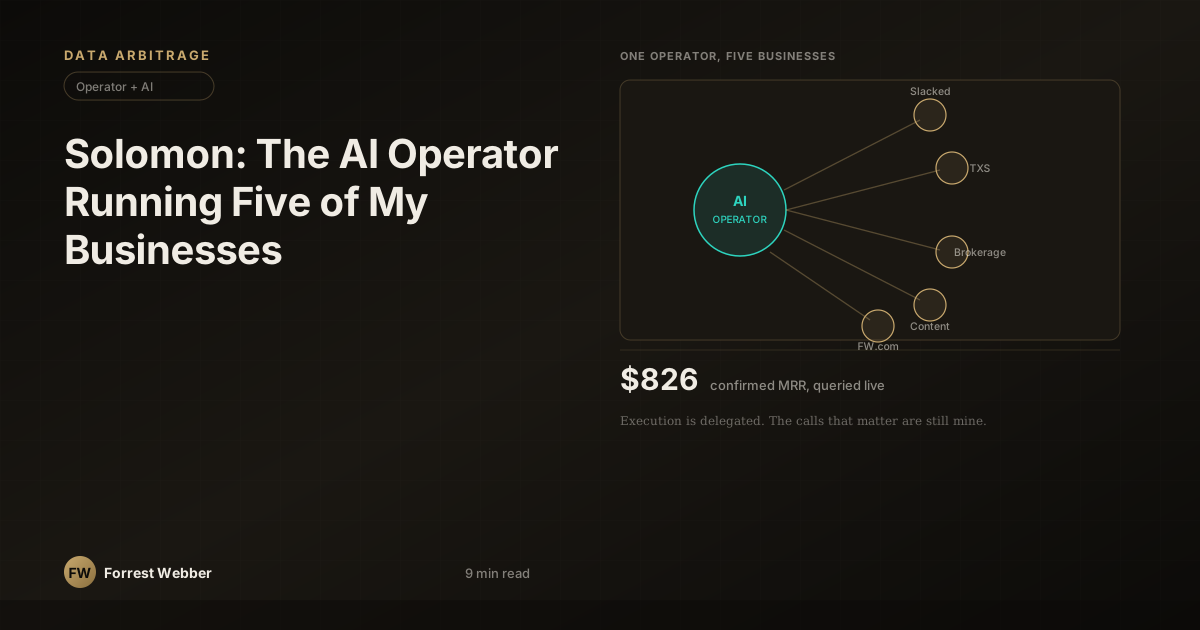
After Wander Media, I didn't rebuild with a team of forty. I rebuilt with one AI operator I call Solomon, running on top of Claude, and today it's the thing that actually keeps five businesses — Slacked, Texas Signals, a real estate brokerage, a couple of content brands, and this website — moving day to day.
I want to describe what that actually means, concretely, because "I use AI to run my business" has become such a throwaway line that it's stopped meaning anything. Most of the time it means someone used ChatGPT to write a blog post. This is a different claim, and I want to earn it with specifics instead of asserting it.
What Solomon actually has access to
Not a chatbot window. An operator with standing access to the actual surfaces a business runs on:
- Three email accounts — reads, triages, and drafts across all of them daily.
- iMessage, read-only — for the parts of the business that still happen over text (client updates, quick approvals, deal flow).
- Every calendar across the businesses.
- The live dashboards — Stripe, Supabase, analytics, deploy status — the same places I'd check myself.
- The databases directly — Supabase projects for Texas Signals, Slacked, and the other brands, queried live rather than remembered from a stale note.
That access is the whole point. An AI that can only chat with you is a search engine with a personality. An AI that can open your inbox, see your actual Stripe subscriptions, and query your actual database is something closer to an employee.
What it does without me asking
Every morning, before I've looked at anything, a health sweep runs across every site and dashboard I operate — is it up, is the last deploy actually live, are the automations still running, what does yesterday's data look like. A backlog gets self-audited and triaged by what will actually move revenue, not by what's oldest in the queue. Inboxes across three accounts get read and sorted, replies get drafted, and the things that need my actual judgment get surfaced instead of buried.
None of that is "AI writes my content for me." It's the unglamorous operational layer — the stuff a chief of staff or an ops manager would do — running continuously instead of waiting for a weekly check-in.
The rule that makes this safe: I keep the calls that matter
The operating philosophy is deliberately narrow, and I've had to correct it in both directions over time. The rule that stuck: technical and strategic calls are mine. Execution is delegated. Solomon doesn't decide what Texas Signals' pricing should be, or whether a client relationship is worth saving, or whether to change what a brand stands for. It executes against decisions I've already made, at a speed and consistency I couldn't sustain solo.
And there are hard lines that don't move, regardless of how good the automation gets:
- No outbound contact to a client, prospect, or investor without me explicitly saying send it. Every external send is gated. Drafts get written; nothing goes out the door unsupervised.
- No destructive account actions — no unauthorized deletions, no irreversible changes — without a human confirming it.
- Big decisions reach me. The system is built to surface, not to silently decide, anything that actually matters.
I say this because the honest version of "AI runs my business" has guardrails, not because guardrails are a nice feature — because the failure mode of an ungated AI operator (an email that shouldn't have gone out, a change that shouldn't have shipped) is exactly the kind of mistake that costs you a relationship you can't easily rebuild. The whole system is designed around that risk, not around maximizing how autonomous it sounds in a pitch.
The honest scorecard, not the highlight reel
Here's where I'd rather undersell this than oversell it, because I think the honest number is more interesting than an inflated one anyway.
Confirmed external revenue across the portfolio, queried live rather than recited from memory, is $826/month. Of that, $797/month (96%) comes from Slacked — real client services work, four active accounts. Texas Signals, the data business, is at $29/month, one paying subscriber, with a few more accounts sitting at-risk (past due or canceling) that I don't count until they're actually confirmed.
That's not a "look how much an AI operator can generate" story. It's the opposite, and I think that's the more useful thing to say out loud: the AI operator hasn't yet turned the content-and-data bets into revenue. What it has done is let one person run the operations of five businesses — the health checks, the inbox, the deploys, the daily triage — at a level that would otherwise require several hires. The revenue still has to be earned by the underlying businesses being genuinely good. Solomon doesn't manufacture demand. It removes the operational drag that used to eat the time I'd otherwise spend creating that demand.
What this replaces
The honest comparison isn't "AI vs. nothing." It's AI vs. the team of forty I described in the last post — the writers, editors, and ops people that Wander Media needed to run twenty sites. That team was necessary at that scale, in that era, doing that kind of work. A meaningful share of what they did — the scheduling, the monitoring, the routine drafting, the status-checking — is now handled by an operator that doesn't take a salary, doesn't need onboarding, and doesn't go home at 6pm. The creative and strategic work — deciding what to build, what's worth saying, which relationships matter — is still entirely mine, and I don't think that part goes away, ever, for a business that wants to stay honest with its customers.
Why I think this is the differentiated thing to write about
There's a version of this blog that's only about data arbitrage — public records, county appraisal rolls, cross-referencing distress signals. I still believe in that thesis completely; most of this blog is that story. But data arbitrage, as a category, is something other smart people are also doing. What's actually unusual is the operating model underneath it: one person, one AI operator with real standing access to real systems, running a small portfolio of real businesses, with hard rules about where the human has to be in the loop.
That's the part nobody else is writing about honestly, because most "AI operator" content is either pure hype (autonomous businesses that don't exist) or pure skepticism (AI can't really do anything useful yet). The actual answer sits in between, and it's less exciting than either extreme: a real operator, with real guardrails, doing real operational work, on a portfolio that is mostly still figuring out how to turn that operational leverage into revenue. That's the honest story, and it's the one I want to keep telling here as it develops.
This is the second post in the series on how I actually run things now. If you want the honest updates — including when a bet doesn't work — the newsletter is where they land first.
Everything in this blog is built on the same data that powers Texas Signals: 8.9M+ property records, pre-foreclosures, tax delinquencies, and distress signals across 150+ Texas counties. Free 7-day trial.
Try Texas Signals FreeCheck out my books on Amazon and Gumroad — same operator voice, deeper frameworks.