Six Years, Twenty Sites, and the Google Update That Erased 94% of It
The first website I ever built was on Yahoo GeoCities, in middle school. I posted a program called Air Alert 2 — a jump-training routine I'd found somewhere — next to some Vince Carter and Michael Jordan dunk videos I'd ripped and reposted. I thought it was a cool little page for other kids who liked basketball. Then I got a letter threatening a $100,000 lawsuit over the video clips, and I deleted the site the same day.
I was thirteen. I didn't know what a DMCA notice was. But I remember exactly what I felt underneath the fear: I liked that I'd built something people could actually go look at. I always wanted to build something online. That part never went away, even after the part where I got scared off doing it.
The slow start
In college I started a couple of blogs. Both died the way most first blogs die — I wrote for a few weeks, the traffic didn't come, and I moved on to whatever felt more urgent that semester. I didn't have a thesis yet. I just liked the idea of an audience showing up to something I made.
Then life did the thing life does: I finished a finance degree, then a Master of Real Estate, and my first daughter was born very early — premature, high-risk, the kind of start that reorders your priorities overnight. I needed to be home. I needed work that didn't require me to be anywhere in particular at any particular hour. So I went back to the thing I'd never actually let go of, and I got serious about it.
What Wander Media actually was
Over the next six years I built what became Wander Media — a portfolio of roughly twenty content sites, mostly built around travel and lifestyle niches, monetized primarily through display advertising (Mediavine) and some direct client work layered on top.
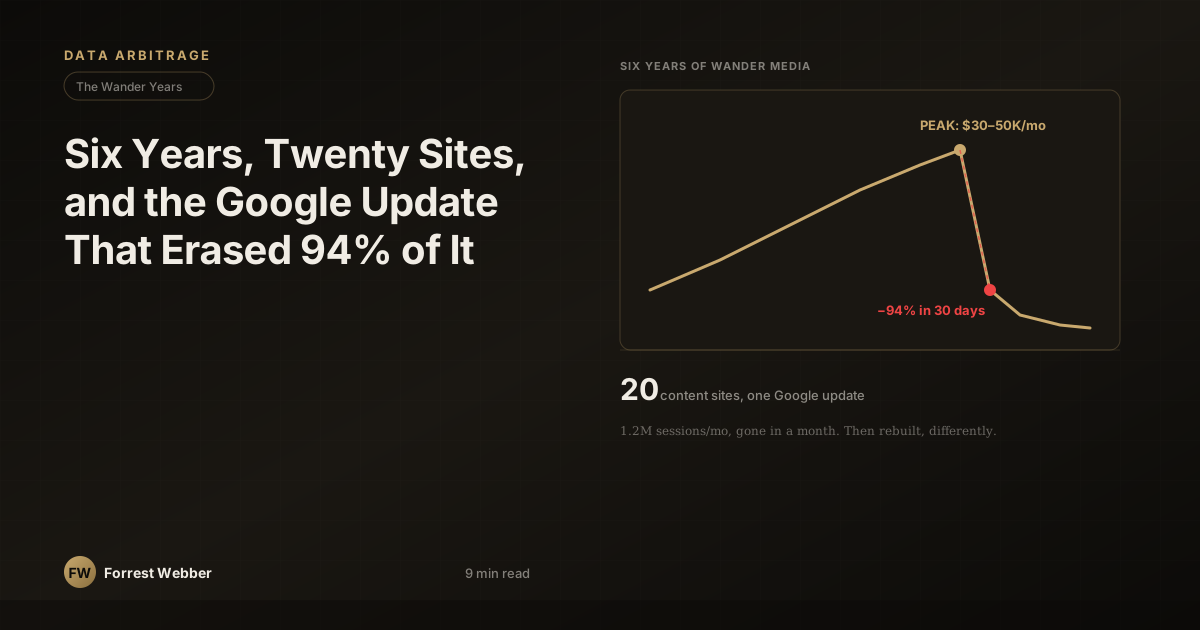
At its peak the portfolio was doing $30,000 to $50,000 a month in total revenue, drawing something like 1.2 million sessions a month across the network. The best single Mediavine ad-revenue month landed around $41,000 to $45,000 on its own. It got covered on Niche Pursuits and Starter Story — the two podcasts that anyone in the content-site space actually listens to — which is its own small proof that the thing was real and not just a spreadsheet I was proud of.
At its biggest, running twenty sites wasn't a one-person operation. I had a team — writers, editors, a couple of people handling the operational and technical side — something like forty people involved across the portfolio at different points, some full-time contractors, some part-time. I want to be honest about the scale here rather than either inflating it or pretending it was a solo hobby: it was a real, mid-size content business, built the slow way, with real payroll and real deadlines.
What actually worked
The mechanics were not complicated, and that's worth saying plainly because people assume content sites are more mysterious than they are:
- Pick a niche with real search volume and real advertiser demand. Travel checks both boxes — people search constantly, and travel/lifestyle brands buy display ads at decent rates.
- Publish consistently, on a schedule, for years. Not months. Years. SEO content compounds slowly and punishes anyone looking for a quarter's worth of results.
- Build the operational layer once, and reuse it across sites. A content calendar, an editorial process, a set of SEO templates, a way to manage freelance writers at scale — build it once, run twenty sites through it.
- Let the ad network do the monetization work. Mediavine's whole pitch is "get the traffic to a threshold and we'll handle turning it into revenue." That's a fair trade if you can hold up your end, which is the traffic.
None of that is a secret. It's the same playbook a lot of people ran in that era. The differentiator was doing it at twenty-site scale, with an actual team, for six consecutive years, without quitting when a site had a bad quarter.
The update that erased it
Then Google shipped what's now generally known as a Helpful Content Update, and in about 30 days I lost 94% of my Google traffic.
I want to be precise about what that number means, because "we got hit by a Google update" has become such a common complaint in this industry that it's easy to read past it. Ninety-four percent isn't "traffic dipped." It's the traffic effectively stopping. The sites that had been pulling in six figures of monthly sessions were suddenly pulling in a rounding error of what they'd had a month before. There was no gradual decline to adjust to. It was a cliff.
The business model was built on Google search traffic converting to ad impressions. When the traffic went, the revenue went with it, on the same timeline. And because the business had real payroll — writers, editors, ops people who depended on that income — the honest, ugly part of this story is that I had to let go of most of the team. Something on the order of forty people, across the life of the portfolio, were affected by what an algorithm update did in a month. That's not a statistic I like citing. It's the actual cost of building on a platform you don't control, and I'd be lying if I told this story without it.
I've thought about that moment in a lot of ways since. The honest read isn't "Google is evil" or "SEO is dead" — plenty of sites survived that update and plenty of new ones have been built successfully since. The honest read is narrower and less comfortable: I had built a business whose entire distribution channel was a single company's ranking algorithm, and when that algorithm's judgment of "helpful content" changed, my business had no say in the matter. I didn't own the audience. I rented visibility from Google, and the rent went to zero without notice.
What I actually learned
A few things, in the order they mattered:
Own the relationship, not just the ranking. A site that ranks well but has no email list, no direct audience, and no reason for someone to come back tomorrow is entirely at the mercy of the algorithm. Everything I've built since — Texas Signals, this blog, the newsletter you're reading this in — starts from "how does someone come back without me needing to rank for anything," not "how do I rank."
Diversify the distribution, not just the niches. Twenty sites in different niches all sounds like diversification. It wasn't. They all depended on the exact same channel — organic Google search — which meant one algorithm decision was correlated risk across the entire portfolio, dressed up as twenty separate bets.
Real businesses have real people in them, and that's a cost you carry, not a line item. I don't say this for sympathy. I say it because it's the piece of operating a company that content-site Twitter conveniently skips over. When the model breaks, it's not just your P&L that takes the hit.
Resilience is a business decision you make in advance, not a feeling you have afterward. The version of me who rebuilt afterward — who eventually built Texas Signals on public county data instead of a rented search ranking, who now runs a portfolio of businesses with an AI operator handling the mechanical load that used to require a team of forty — made different structural choices because of what happened in that thirty-day window, not despite it.
Where this leads
I don't tell this story to be dramatic about it. I tell it because it's the actual origin of almost everything I build now. The instinct to own first-party data instead of renting a ranking. The instinct to keep infrastructure lean enough that one bad month doesn't require me to lay off forty people. The instinct to build products people pay for directly, instead of products that only make money if an ad network's fill rate holds steady.
Wander Media wasn't a failure I'm hiding from. It was a real, six-year business that did real revenue, employed real people, and got wiped out by a platform risk I hadn't priced correctly. Everything after it — including the AI-operator model I run today, including Texas Signals, including this blog — is downstream of learning that lesson once, expensively, instead of learning it twice.
This is the first post in a short series on how I actually got here — not just the data-arbitrage thesis, but the operator history underneath it. If you want the rest of it as it lands, the newsletter is where it goes first.
Everything in this blog is built on the same data that powers Texas Signals: 8.9M+ property records, pre-foreclosures, tax delinquencies, and distress signals across 150+ Texas counties. Free 7-day trial.
Try Texas Signals FreeCheck out my books on Amazon and Gumroad — same operator voice, deeper frameworks.