Why Your Skip-Trace Match Rate Is 65%, Not 95% (And Who's Lying to You)
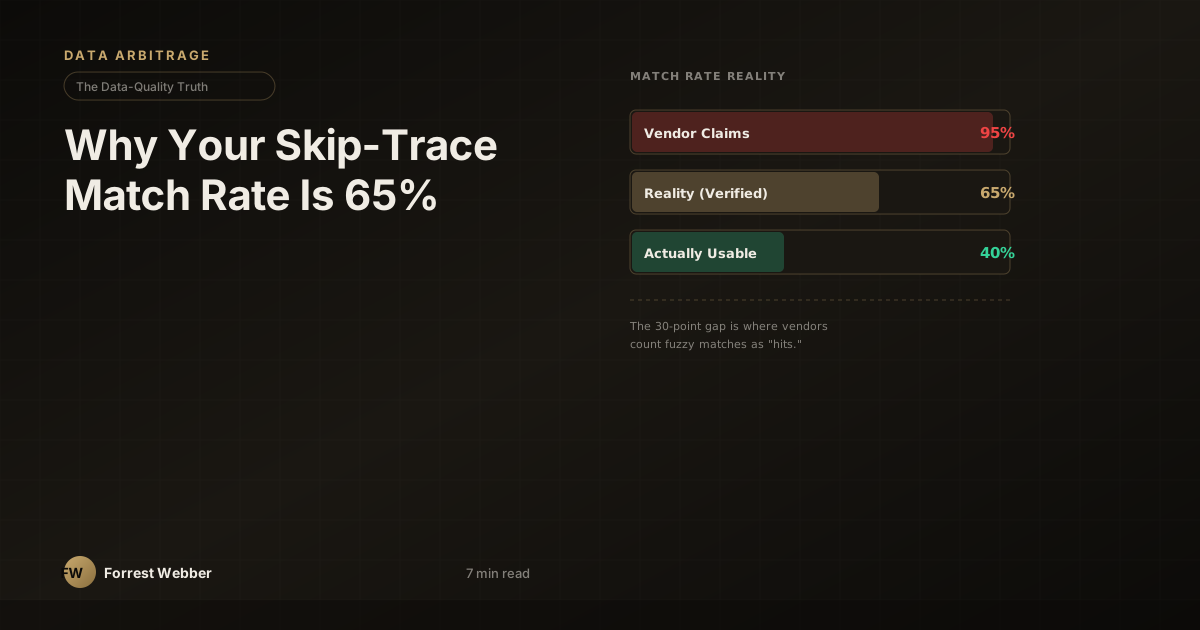
A vendor told me their data would match 95% of my list. I ran a 1,000-record sample through it. The real number — names tied to a phone I could actually dial — was about 64%. Neither of us was surprised, but only one of us was being honest about it.
That gap, 95 versus 64, is the most expensive misunderstanding in the property data business. Whole acquisition models get built on the 95. Cold-call dialers get staffed for it. Direct-mail budgets get sized around it. And then the list comes back, and the math that looked like a machine turns out to be a leaky bucket — and most people blame their script, or their offer, or themselves, instead of the number that was wrong from the start.
So let's fix the number.
What "skip-trace" actually does
Strip away the branding and skip-tracing is one task: you hand a vendor a name and a property address, and they hand you back a way to reach that person — a phone, an email, sometimes a relative. That's it. It's a matching problem. You have one anchor (the address) and you're trying to chain it to a moving target (a human being and their current contact info).
The trouble is that almost everything about that chain is decaying or ambiguous, and a 95% claim quietly pretends it isn't.
Why the real number is ~65%
Here's what eats the other thirty-five points, in roughly the order it bites:
- The data is stale. Americans move more than ten times in a life. Phone numbers churn constantly. The number a database "knows" was true when the database last refreshed — which might be eighteen months ago. A match to a disconnected line is still counted as a match.
- Common names break the chain. There are a lot of Maria Garcias and James Smiths. When the name is common and the address is an apartment, the vendor is guessing which human you mean. Sometimes it guesses wrong, confidently.
- The owner isn't the resident. A huge share of property is owned by someone who doesn't live there — renters fill the house, the owner is three states away. Trace the address and you get the tenant's phone, not the owner's. Right address, wrong person.
- The owner is an LLC or a trust. "JLM Holdings LLC" doesn't have a cell phone. The actual human is hidden one or two layers up, and unwinding that is real work most pipelines skip.
- Multiple people, one roof. Adult kids, roommates, an ex still on the deed. The database returns a person at the address. Coin flip whether it's yours.
- The number's just dead. Disconnected, ported, reassigned to a stranger. The match looks perfect on the spreadsheet and rings to nobody you want.
Stack those and you don't land at 95%. You land in the low-to-mid 60s for genuinely usable contacts. Every honest operator I know quietly works off that number — and budgets around it instead of being ambushed by it.
How 65% gets dressed up as 95%
The vendors aren't (usually) lying outright. They're counting generously, and they're counting things you'd never count if you saw the definitions.
- Any partial match counts. Found a phone associated with an address? That's a "match," even if it's the tenant's, even if it's dead.
- Wrong is still a hit. The match rate rarely subtracts the records where they returned the confident wrong person. You only discover those by dialing.
- "We found something." An email with no phone, a relative's number, a landline from 2014 — all roll into the headline percentage.
Then there's the line that should make you laugh out loud: "3,200 data sources." It sounds like a moat. It's mostly the same handful of underlying compilers, resold and re-aggregated through 3,200 doorways. More sources stacked on stale, ambiguous inputs doesn't get you a better answer — it gets you the same wrong answer, corroborated. Volume of sources is a marketing number. It tells you nothing about whether the phone rings.
How to actually evaluate a data vendor
Here's the part competitors with a black-box pipeline can't hand you, because it would expose their own numbers. Four questions:
- "What's your match rate on my list?" Not the brochure average — your list, your county, your property type. LLC-heavy commercial traces very differently from owner-occupied single-family. The honest vendor will run a sample. The nervous one will quote the brochure.
- "Define a match." Make them say it out loud. Does a relative's number count? A dead line? An email-only hit? If "match" includes things you can't dial, their 95% and your 95% are different words.
- "Let me test a sample." Pay for 500–1,000 records before you commit to 50,000. Anyone confident in their data will let you. Anyone who won't is telling you something.
- Measure connect rate, not match rate. This is the whole game. Match rate is what the vendor counts. Connect rate is what you experience — the percentage of records where a real, right human actually answered. Run your sample, dial it, and write down your own number. That number is the truth. Everything upstream is marketing.
A 65% match rate that's honest will outperform a 95% rate that's inflated, every time — because you'll size your budget, your staffing, and your expectations to reality instead of to a slide.
Why I can say this out loud
I can be this blunt because of how I source data. When you pull public records yourself — a county property roll, a deed file, a filing — you're standing at the source. You can see the staleness. You can see the LLC sitting where a human should be. You can see exactly where the chain breaks, because you're holding both ends of it. There's no black box to hide the truth inside, and no incentive to round 65 up to 95.
That's the quiet advantage of going to the source instead of buying the polished export: you get to see the quality, honestly, before you bet a quarter on it.
The 95% was never real. Now you know the four questions that get you to the number that is. Most people will keep budgeting off the brochure. You don't have to.
Everything in this blog is built on the same data that powers Texas Signals: 8.9M+ property records, pre-foreclosures, tax delinquencies, and distress signals across 150+ Texas counties. Free 7-day trial.
Try Texas Signals FreeCheck out my books on Amazon and Gumroad — same operator voice, deeper frameworks.